
Let’s be honest. If you love food, enjoy feeding large groups, and have even a little bit of kitchen experience, you have probably thought about this.
Wedding catering in India is one of those businesses that looks chaotic from the outside but runs on a surprisingly repeatable system once you understand it.
And the numbers back it up. India’s wedding catering services market was valued at USD 16.19 billion in 2025 and is projected to reach USD 28.63 billion by 2032, growing at a CAGR of 12.08%[1].
That is not a niche market. That is a mainstream, high-demand, high-repeat business that operates in every city, town, and tehsil in India.
If you are thinking about getting in, here is exactly how to do it.
What Wedding Catering Actually Looks Like in India
Before we get into steps, let’s be clear on what you are signing up for.
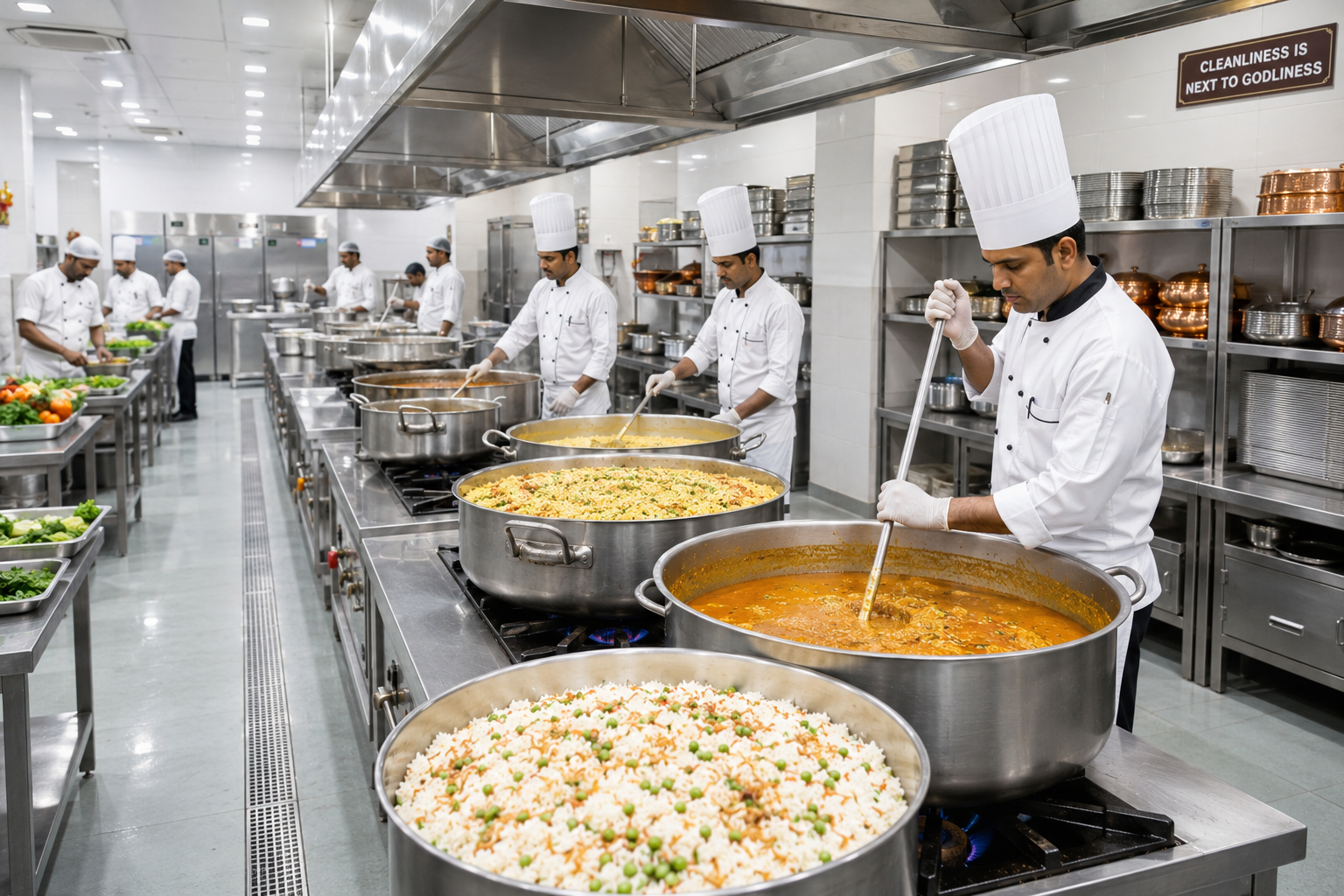
Wedding catering in India is not just cooking food. It is managing:
- Large volumes (200 to 2,000 guests in a single event)
- Multiple live counters (chaat, juice, coffee, desserts)
- Multiple meals across multiple days (haldi lunch, sangeet dinner, reception buffet)
- A tight timeline where food needs to be hot, ready, and replenished continuously
It is a logistics business as much as a food business. The caterers who succeed long-term are the ones who treat it that way.
Step 1: Decide What Kind of Caterer You Want to Be
Not all wedding catering is the same. There are distinct types, and your starting resources will determine which one makes sense for you.
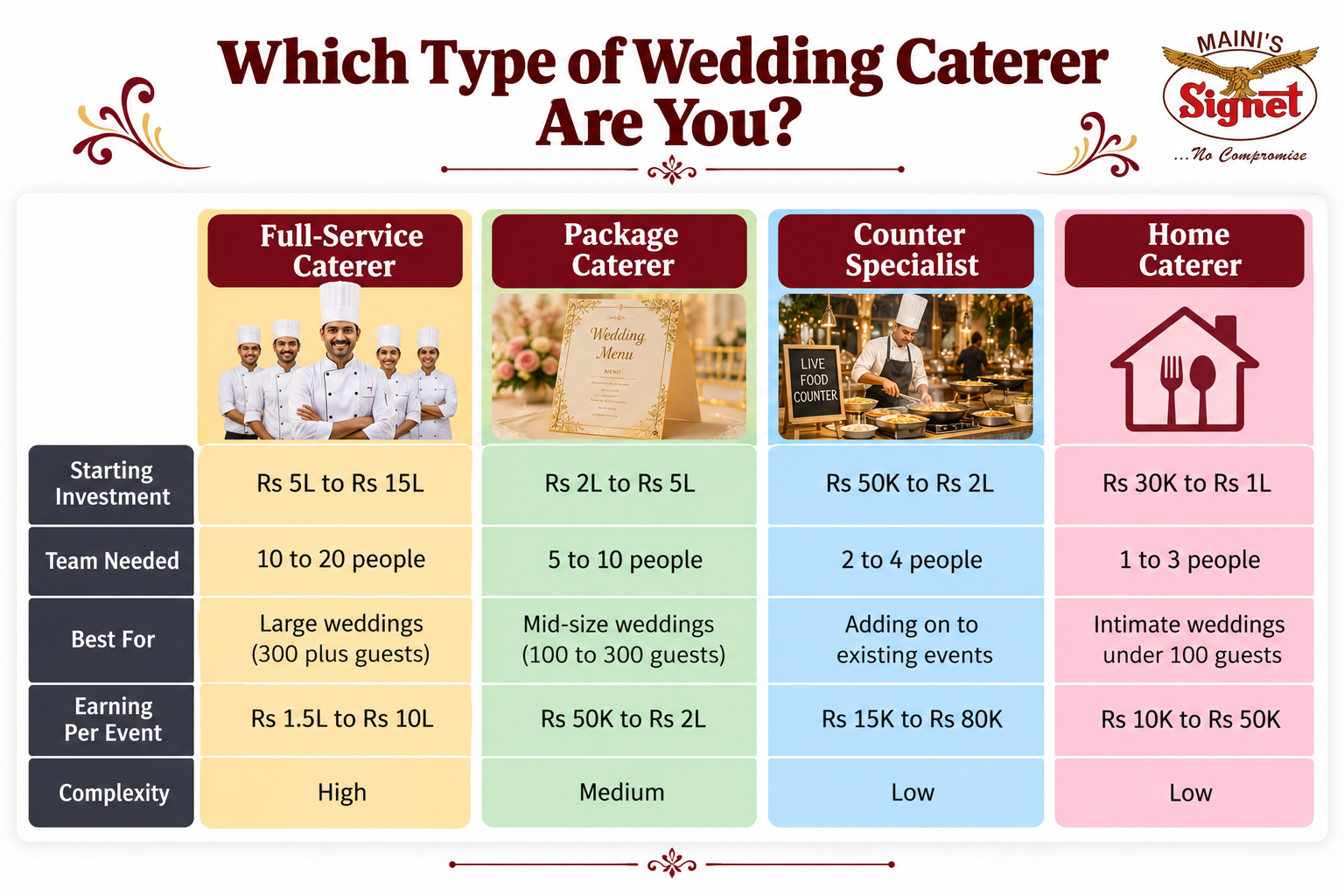
Full-service wedding caterer: You handle everything, from kitchen prep to serving to cleanup. This requires a bigger team and investment but earns the most per event.
Package caterer: You offer fixed menus at fixed per-plate prices. Easier to quote, easier to execute, and popular in smaller cities where clients want straightforward pricing.
Specialist counter caterer: You focus on a single high-demand live counter, for example chaat, Chinese, or pizza. Lower investment, easy to scale, and most event planners actively look for reliable counter vendors.
Home/cottage caterer: You cook from a home kitchen and target intimate weddings of under 100 guests. Great starting point. Lower overheads, easier logistics, and still a legitimate income.
Start with whichever model your current kitchen setup and budget support. You can always expand later.
Step 2: Sort Out Your Kitchen Setup
Your kitchen is your production unit. Get this right before you take a single booking.
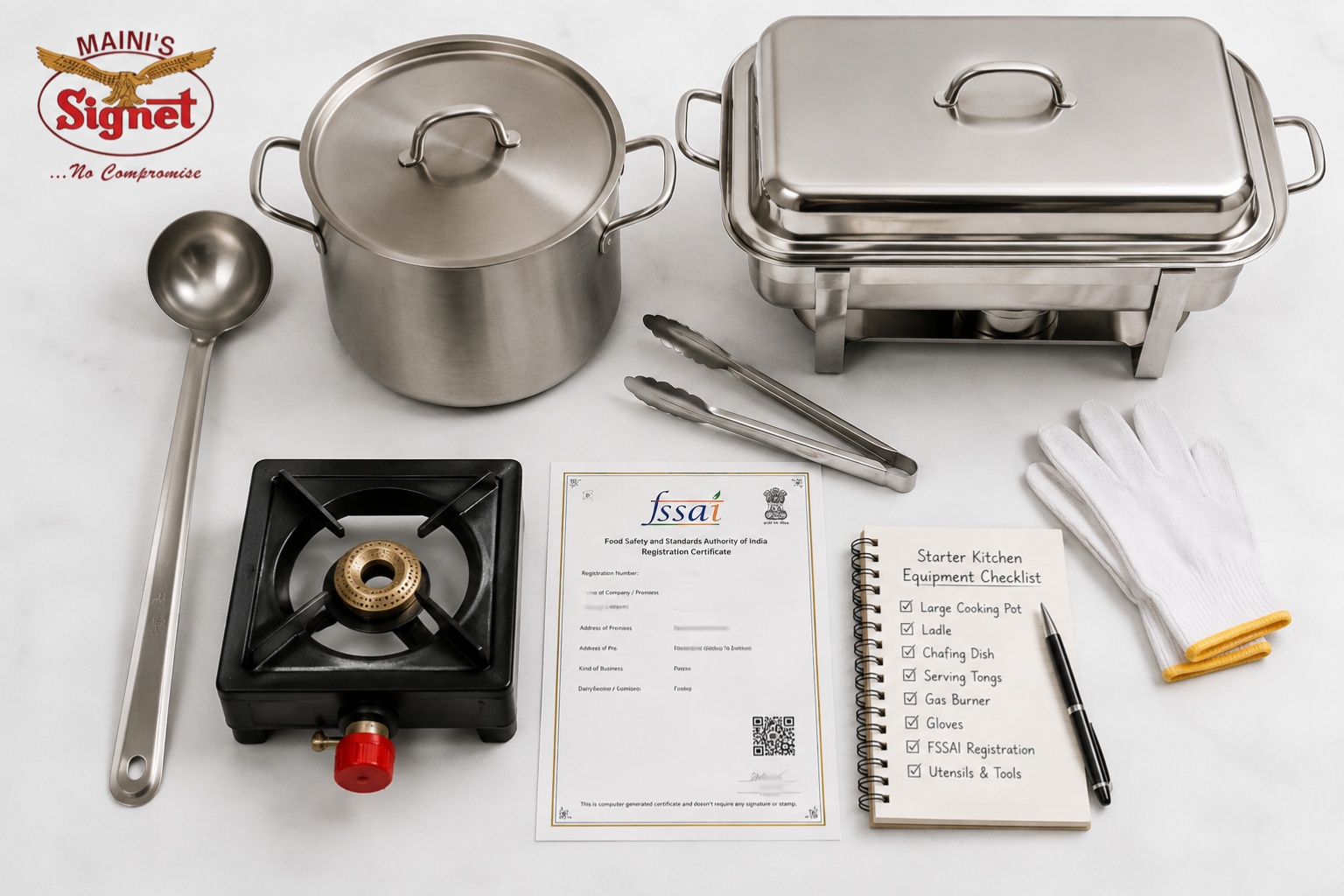
What you need at the minimum:
- A commercial-grade gas burner setup (at least 2 to 4 burners)
- Large stainless steel vessels (minimum 20L, 40L, and 60L capacity)
- A cold storage unit or large refrigerator for ingredient storage
- Food-grade storage containers and serving trays
- A clean, covered prep area that meets basic hygiene standards
If you are starting from a home kitchen, keep your initial bookings small (under 150 guests) until you have the right equipment in place.
One thing most new caterers overlook: invest in a good coffee counter setup early.
Registered catering services have access to FSSAI’s Food Safety Training and Certification (FoSTaC) programme, which helps train food handlers and improves compliance with food safety norms. But beyond compliance, a professional hot beverage counter adds perceived value to your service in a way guests notice immediately.
Maini’s Signet coffee machines are widely used at wedding catering setups across India and are built for continuous high-volume service.
Step 3: Get Your Licenses in Order (FSSAI First)
This is the one step you cannot skip or delay. Every catering business in India, regardless of size, needs an FSSAI registration or license before it starts operations.
Operating a catering business without an FSSAI license risks a fine of up to Rs 5 lakh and potential closure during a live event, which can be devastating for your reputation.[2]
Here is how the FSSAI tiers work for caterers:
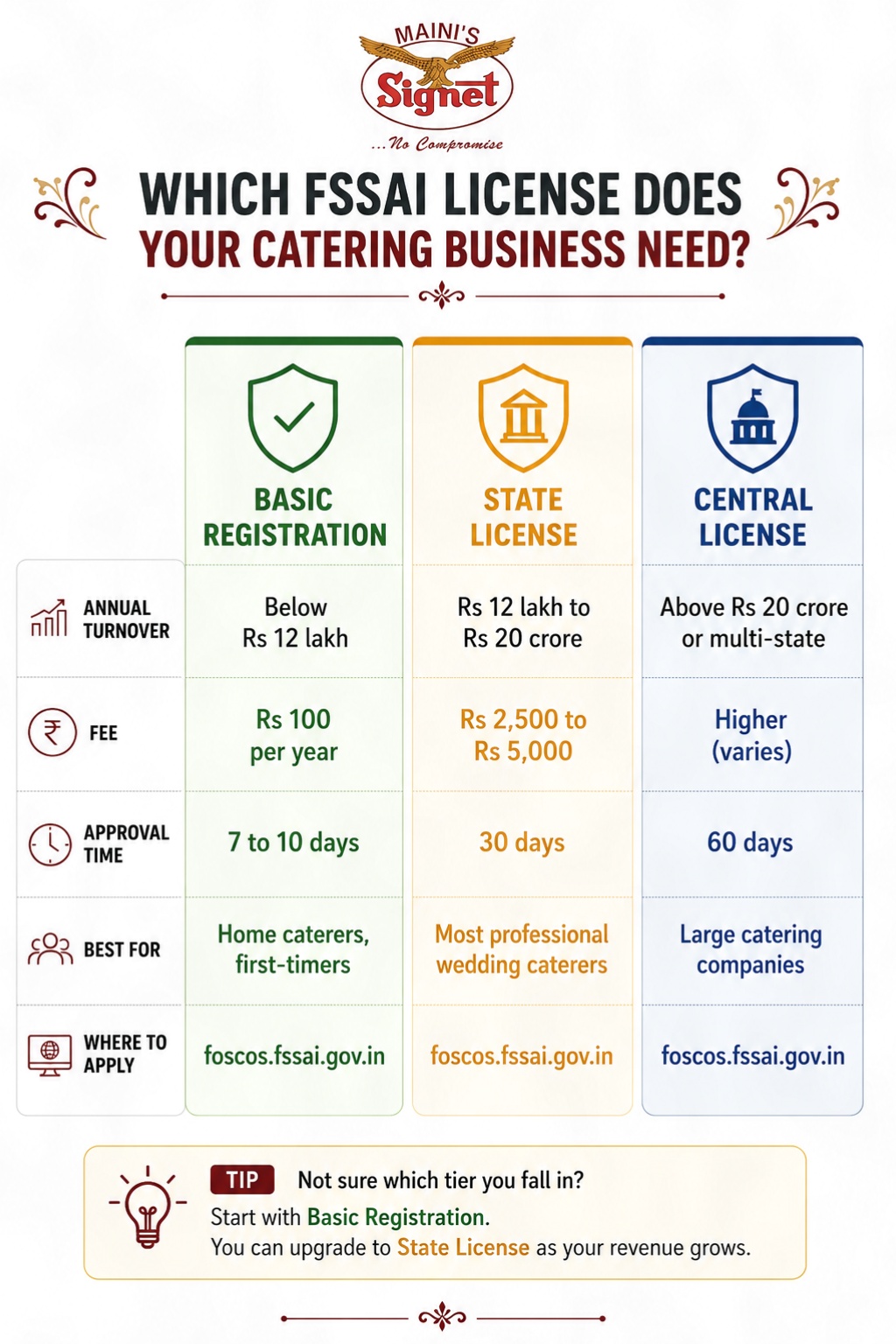
Basic Registration (Form A): For annual turnover below Rs 12 lakh. Fee: Rs 100 per year. Approval in 7 to 10 days. Good enough to start legally as a small-scale home caterer.
State FSSAI License: For caterers with annual turnover between Rs 12 lakh and Rs 20 crore. Issuance fees range from Rs 2,500 to Rs 5,000, with validity of 1 to 5 years.[3] This is the license most professional wedding caterers need.
Central FSSAI License: For catering services with annual revenues over Rs 20 crore or those operating across multiple states.[4]
Apply through the official FoSCoS portal at foscos.fssai.gov.in. The process is fully online.
Other registrations you will need:
- Udyam (MSME) Registration at udyamregistration.gov.in – free, takes 10 minutes
- GST Registration at services.gst.gov.in – mandatory once turnover crosses Rs 20 lakh, or if corporate clients ask for invoices
- Trade license from your local municipal authority if operating from a commercial kitchen
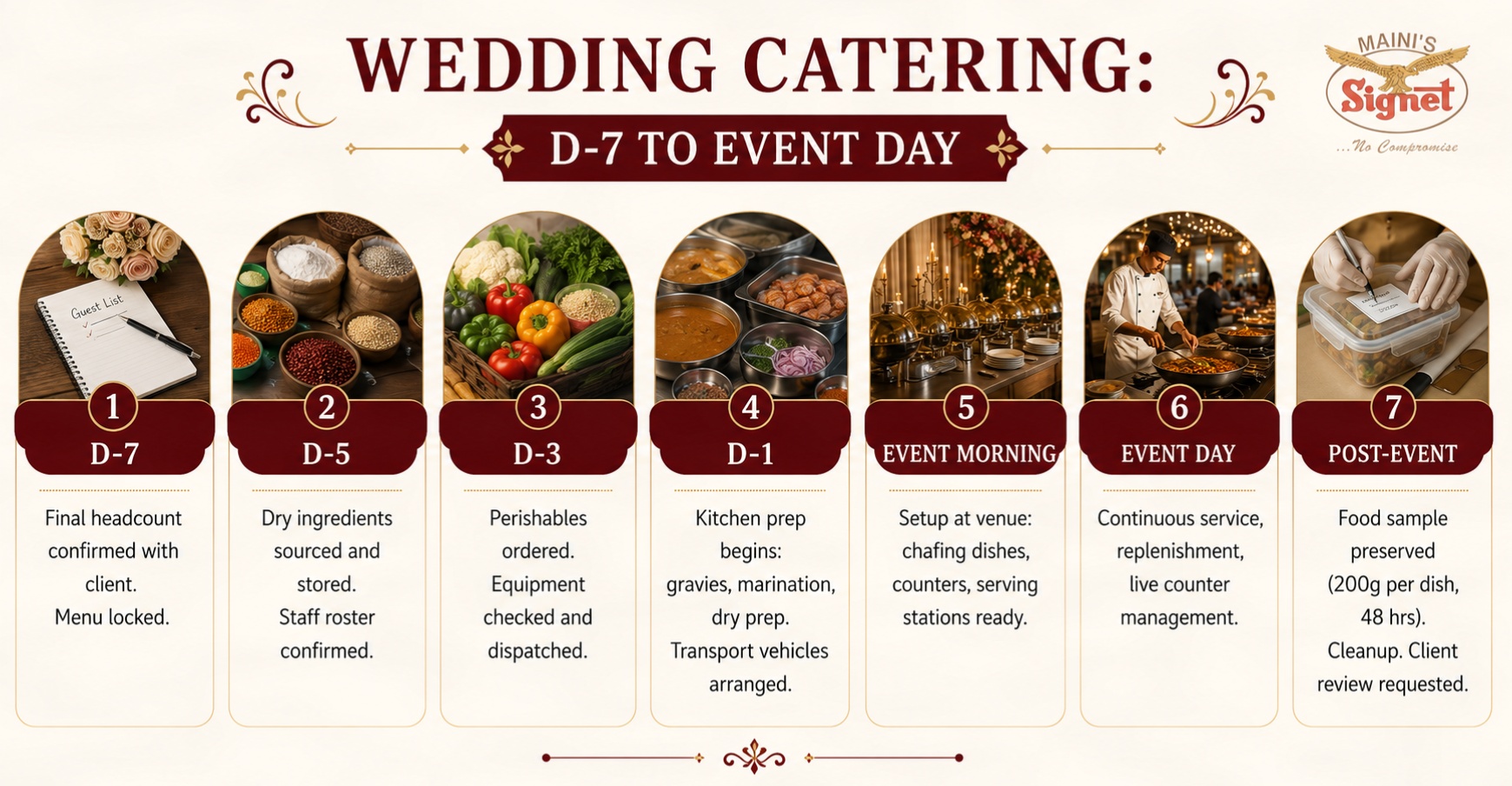
One important compliance detail most beginners miss:for large events, keep a food sample of minimum 200g from each dish served, sealed and refrigerated, for 48 hours after the event. This protects you if a food safety complaint arises.
For a complete document-by-document checklist, our event business registration guide covers every step.
Step 4: Build Your Menu
Your menu is your pitch. Keep it tight when you start.
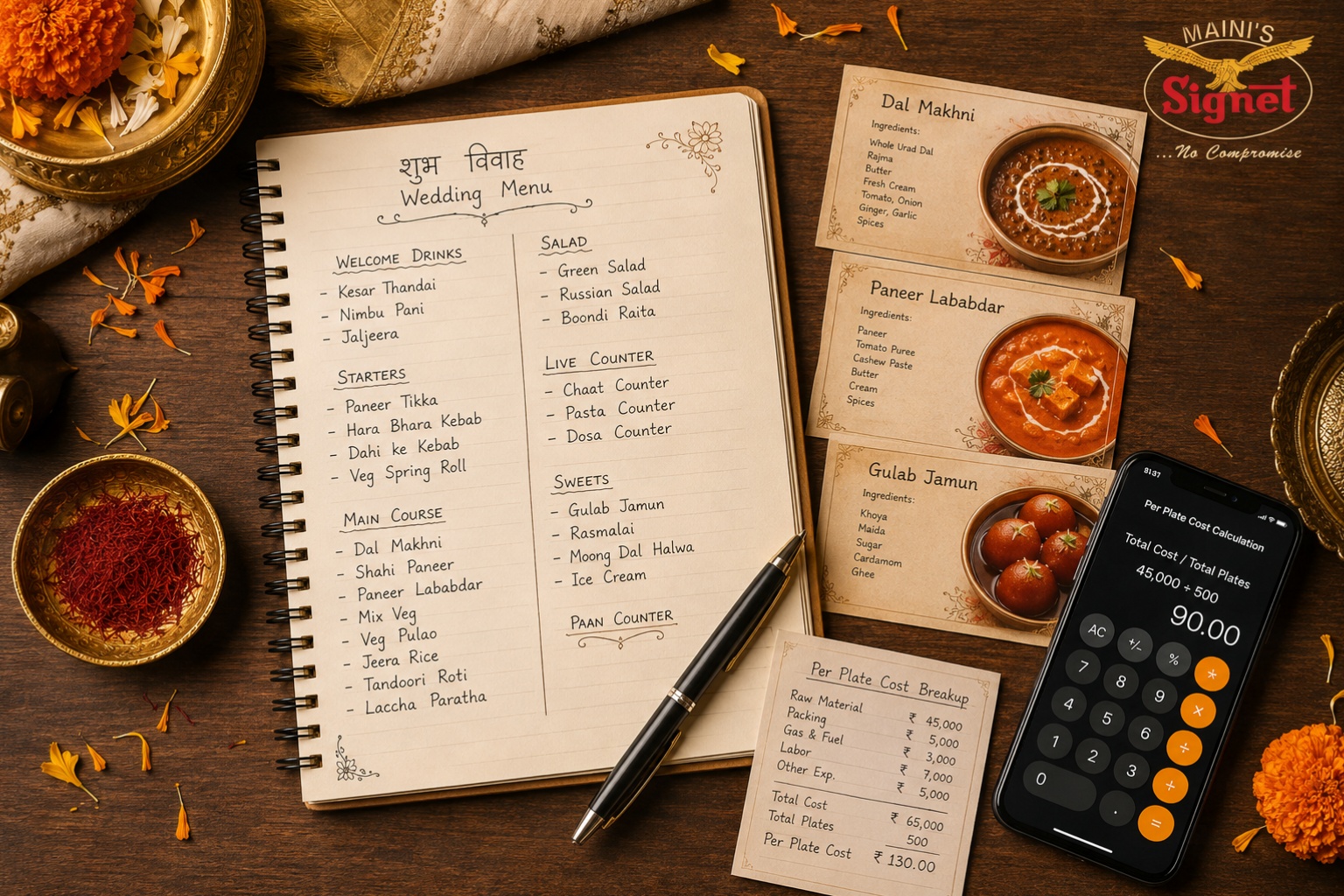
A sprawling menu of 80 dishes sounds impressive but creates operational chaos. A focused menu of 30 to 40 items that you execute consistently well is far more profitable.
Structure your menu around:
- A core North/South Indian thali or buffet depending on your region and clientele
- At least two vegetarian and one non-vegetarian set
- A live counter offering (chaat, pasta, or stir-fry) since these are high-visibility upsells
- A dessert station (gulab jamun, kheer, ice cream are safe, crowd-pleasing staples)
Pricing your menu:
Per-plate pricing in India currently ranges from Rs 400 to Rs 500 for basic vegetarian setups to Rs 1,500 to Rs 3,000 per plate for premium multi-counter wedding buffets in metros.
Your cost of food (raw ingredients) should ideally not exceed 30 to 35% of your per-plate charge. Everything above that covers labour, fuel, transport, equipment depreciation, and your margin.
Step 5: Build a Team Before You Take Large Bookings
This is where most first-time caterers underestimate the work.
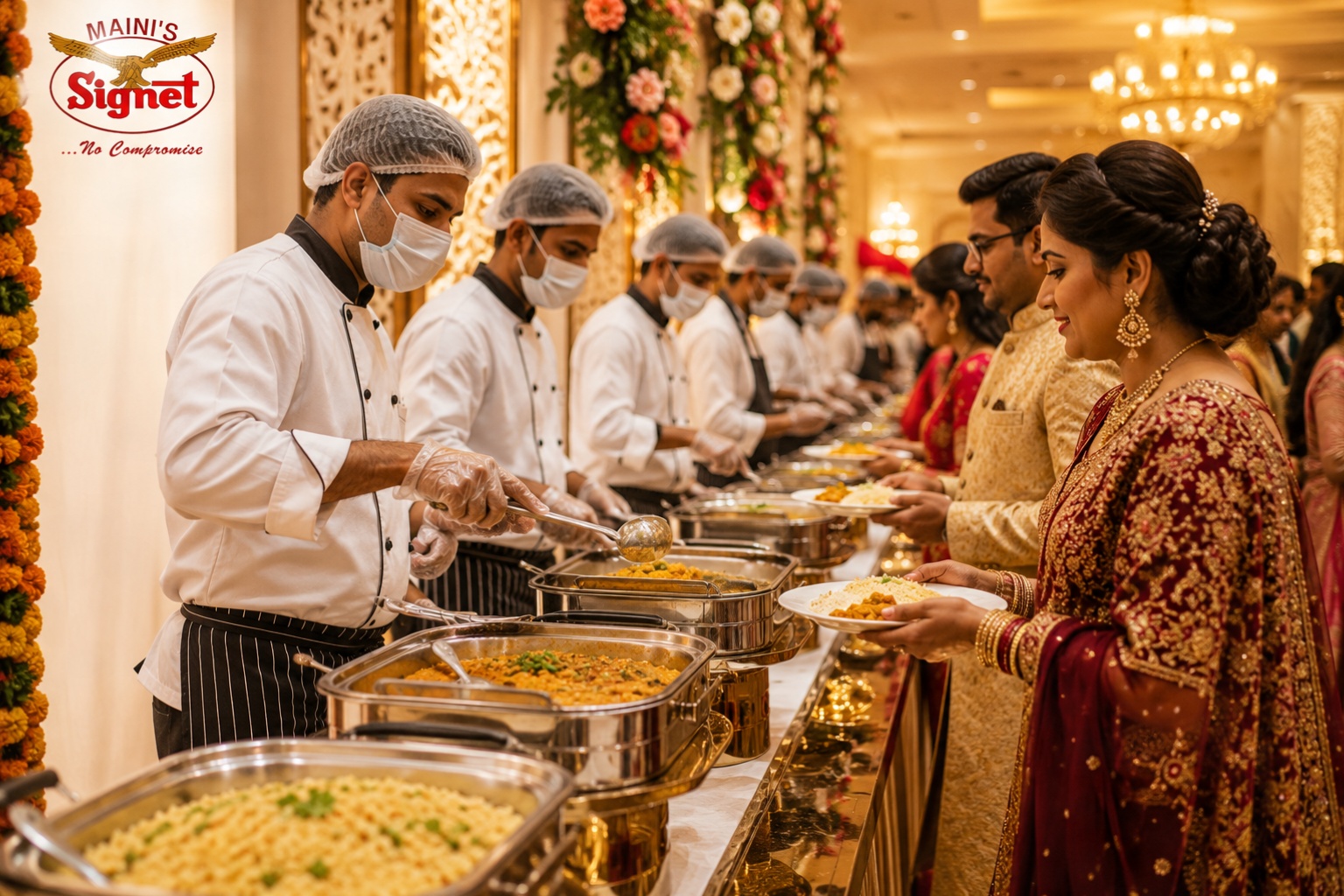
A 500-guest wedding buffet service needs, at minimum:
- 2 to 3 cooks
- 4 to 6 serving staff
- 1 to 2 helpers for replenishment and cleanup
- A supervisor (which is often you, at the start)
You do not need to hire all of these people permanently. Build a reliable pool of part-time workers you can call in per event. This is how most small and mid-size caterers in India operate.
Step 6: Price Your Services
There are two ways to quote:
Per plate pricing: Easiest for clients to understand. You quote a per-person price that includes food, setup, serving staff, and cleanup. Make sure you are quoting based on confirmed headcount, not approximate.
Package pricing: You offer fixed packages (for example, “Package A: 4 dishes, 2 desserts, 1 live counter for up to 300 guests at Rs X”). Easier to sell, faster to close, and avoids last-minute negotiation.
Always collect an advance. A minimum of 40 to 50% before you start purchasing ingredients or booking staff. Never start prep work on a verbal commitment alone.
Also, include a clause in your agreement for headcount changes within 48 hours of the event. Guests numbers in Indian weddings can swing by 20 to 30% in the final days.
Step 7: Get Your First Bookings
You need a portfolio before clients trust you. So build one, even if it means taking your first job below market rate.
Here is what actually works:
- Cater a family event at no charge in exchange for photos, a video, and a testimonial
- Partner with a wedding planner or decorator and offer to be their go-to caterer for smaller functions
- Get listed on WedMeGood and Sulekha under local caterers in your city
- Create an Instagram page and post photos of your food, setups, and live counters. Food content consistently gets shared across wedding planning groups.
- Call banquet halls directly and ask if they have an empanelled caterer list. Many halls allow outside caterers and actively refer them to clients.
After every event, ask for at least one Google review. A catering business with 15 to 20 verified local reviews outranks and out-converts one with a better menu but no social proof.
FAQs
A basic home kitchen setup can be started with Rs 50,000 to Rs 1.5 lakh. A proper commercial catering operation with a dedicated kitchen and full equipment can require Rs 5 lakh to Rs 15 lakh or more depending on scale.
Not necessarily. Many successful caterers start from home kitchens for small events under 100 guests. As you scale, investing in a dedicated space becomes important for FSSAI compliance, capacity, and hygiene.
Yes. Even if you run a food business from home, FSSAI registration is mandatory. If your turnover is below Rs 12 lakh, a Basic Registration at Rs 100 per year is all you need to start legally.[5]
Yes, and most people start this way. Take weekend bookings, build your portfolio, and shift to full-time once you have consistent demand.
Start with your business structure, then stack the registrations on top of it. Most new caterers begin as a sole proprietorship, which requires no formal incorporation. From there, get your Udyam (MSME) Registration at udyamregistration.gov.in for free, apply for FSSAI registration through foscos.fssai.gov.in, register for GST at services.gst.gov.in once your turnover crosses Rs 20 lakh, and get a trade license from your local municipal body if you are operating from a commercial kitchen. That covers you legally for most wedding catering work in India.
There are four you genuinely need:
FSSAI Registration or License – mandatory for all food businesses without exception
Udyam (MSME) Registration – free and builds credibility with vendors and clients
GST Registration – required above Rs 20 lakh turnover; corporate clients will ask for it regardless
Trade License – from your municipal authority if operating from a fixed commercial premises
For large public events (1,000 plus guests), some states also require a temporary food business permit from the local FSSAI or municipal authority, applied per event.
For most beginners, sole proprietorship is the right starting point. It is simple to set up, has no minimum capital requirement, and can be running in under a week. If you are starting with a partner, a partnership firm or LLP makes more sense. Go for a Private Limited Company only if you plan to scale fast, hire a large team, or want to attract institutional clients or investors. The structure you choose affects your tax filing, liability, and ability to open a business bank account, so match it to your actual ambition for the business, not just what sounds impressive.
Yes, without exception. Even if you run a food business entirely from home, FSSAI registration is mandatory under Indian law. If your annual turnover is below Rs 12 lakh, a Basic Registration at Rs 100 per year is all you need to start legally. (MAS LLP, 2026) As you grow and cross Rs 12 lakh in revenue, you upgrade to a State FSSAI License. Skipping this is not worth the risk. Operating without a valid FSSAI license can result in a fine of up to Rs 5 lakh and closure during a live event.
These are the ones that actually bring in enquiries:
WedMeGood – India’s largest wedding planning marketplace.
Sulekha – Strong for local catering searches, especially in Tier-2 and Tier-3 cities.
JustDial – Still heavily used for “caterers near me” queries across India, especially by older decision-makers in the family.
Google Business Profile – Set this up before anything else. Most first contacts happen through Google Search and Google Maps.
Instagram – Food content performs exceptionally well here. Before-and-after setups, live counter videos, and plated food shots consistently reach wedding planning audiences.
IndiaMART – Useful if you want to attract corporate clients or bulk orders alongside weddings.
Start with Google Business Profile and one wedding marketplace. Add platforms as your capacity to manage enquiries grows.
The simplest approach is to build up from your cost, not down from what competitors charge. Calculate your raw ingredient cost per plate first. For most Indian wedding menus, this typically runs between Rs 120 and Rs 350 per plate depending on dishes. Add your labour cost, fuel and transport, equipment use, and a 20 to 25% margin on top. That gives you your floor price. Then check what caterers at a similar quality level are charging in your city and position just below premium but above the cheapest option in your market. Avoid pricing low to win clients. It fills your calendar with the most demanding customers for the least money, and those clients rarely refer you upward.
A cleaner way to structure it is to offer three tiers:
Standard – set menu, no live counters, serving staff only
Premium – extended menu plus one live counter
Luxury – custom menu, multiple live counters, branded presentation
This makes upselling natural and gives clients a choice instead of a negotiation.
The non-negotiables for a professional catering setup are:
– Commercial gas burners (2 to 4 burner range minimum)
– Large capacity stainless steel vessels (20L, 40L, 60L)
– Chafing dishes and fuel canisters for buffet service
– Cold storage or commercial refrigerator
– Insulated food transport containers
– Serving trays, ladles, tongs, and disposable gloves
For counters, coffee machines, popcorn machines, and candy machines are high-visibility upsells that clients and guests both appreciate.
Maini’s Signet has manufactured and supplied commercial catering counter equipment to caterers, event companies, and tent house operators across India since 1961. Direct from manufacturer means better pricing and reliable after-sales support. Browse the full product range or call/WhatsApp at +91-9811150123 for a recommendation based on your event volumes.
The Equipment Side of Catering
Running a smooth catering service at a wedding depends heavily on the right counter equipment.
Maini’s Signet supplies commercial coffee machines, popcorn machines, and candy machines to caterers and event companies across India. These are purpose-built for the high-volume, continuous-use demands of Indian weddings and events.
Browse the full product range or call/WhatsApp at +91-9811150123 to find the right equipment for your setup.
And if you are still exploring how this fits into a broader events business, these guides will help:
- How to Start an Event Management Business in India
- How to Start a Wedding Planning Business in India
- Event Management Equipment List
References:
- https://www.marknteladvisors.com/research-library/wedding-catering-services-market-india.html ↩︎
- https://velcolegalindia.com/blog/fssai-license-caterers-event-food-services-india ↩︎
- https://www.restroworks.com/blog/food-license-for-restaurant/ ↩︎
- https://www.onlinelegalindia.com/blogs/fssai-food-license-catering-services-in-india/ ↩︎
- https://masllp.com/register-your-food-business-in-india-complete-guide-on-fssai-registration/ ↩︎